
Blog
Smart Routing for Smarter Fintech Decisions
Use Cases for Lending, Payments, and Beyond
When we talk about smart routing, it’s easy to focus on the mechanics—how multiple data aggregators are evaluated in real-time, how the best provider is selected for a specific need, or when fallback options need to be triggered. But what does this look like in practice? Let’s break it down through three real-world use cases in fintech: account funding, transaction monitoring, and cash-flow based underwriting.
1. Account Funding: Converting More Users, Securely
One of the biggest challenges with account funding is ensuring your users can effectively link and authenticate their bank accounts during onboarding. Rely too heavily on a single aggregator, and you risk being unable to authenticate their accounts. Go the manual route—asking your users to enter their account and routing numbers themselves—and you’re inviting issues like typos, user drop-off, or even fraud.
Luckily, this is where smart routing shines:
- Better Coverage: By leveraging multiple data aggregators, you ensure higher bank coverage, and that increases the likelihood your customer will successfully authenticate their account. That, in turn, reduces churn.
- Favoring OAuth: OAuth connections (and tokenization) allow the underlying account and routing data to be shared without the need to handle sensitive PII directly. This enhances your security, supports your compliance posture, and builds trust with your users.
The result? Fewer users drop off, and more accounts get funded.
2. Transaction Monitoring: Comprehensive Coverage for Multiple Accounts
For use cases like personal finance management (PFM) or credit stacking, users often connect multiple accounts across various banks. Relying on a single aggregator leaves gaps—users might find one bank but not another, resulting in an incomplete financial picture. Missed connections frustrate users, create drop-offs, and limit the value of your platform. Without deep, reliable coverage across many providers, you risk losing the trust and engagement of your users entirely.
The key to success here– again– is global coverage:
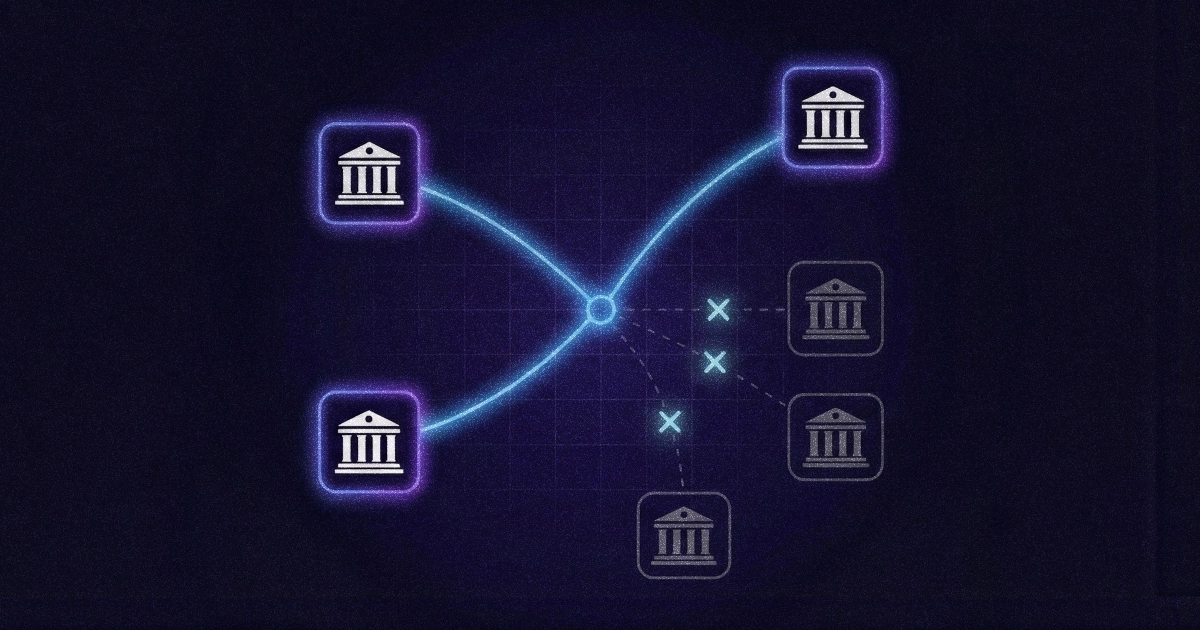
- Broad Aggregator Reach: With multiple providers under the hood, users are more likely to find all their banks, delivering a richer, more complete financial picture. Aggregator A supports Bank of America but not First Capital Bank of Texas? No problem—Aggregator B can pick up the slack and support First Capital Bank of Texas.
- Data Fidelity: Smart routing allows you to go a step further and dynamically choose the right aggregator for each account– i.e. OAuth wherever it’s available– ensuring a higher reliability for the data you’re pulling down, with minimal errors.
This translates to happier users who can manage their finances more effectively, and fintechs that deliver more value.
3. Underwriting: A 360° View of Financial Health
Underwriting based on cash flow data relies on accurate, comprehensive data to effectively assess risk. Missing accounts, or relying on incomplete or inaccurate transaction histories can skew risk assessments and lead to bad credit decisions. Without robust coverage and reliable data, you’re not just risking inefficiency—you’re risking inaccurate underwriting that undermines trust and profitability. Smart routing corrects for this:
- More Data Sources: Again, broader coverage ensures lenders can access all relevant accounts, providing a complete view of an applicant’s financial health.
- Reliable Connections: By favoring secure, high-quality connections like OAuth, smart-routing minimizes gaps and ensures the data is up-to-date and trustworthy– with minimal latency.
The upside? Faster, more accurate underwriting decisions that help fintechs scale lending operations more confidently.
Why Smart Routing Matters
Across these use cases, the benefits of smart routing are clear:
- Broader coverage means fewer coverage gaps, more connections, and happier users.
- Higher conversion rates because users can connect their accounts more reliably– whether they’re funding, monitoring, or applying for loans.
- Improved security by prioritizing OAuth and tokenization means sensitive data stays protected.
- More reliable data and better latency via real-time routing ensures faster connections and higher-quality data– reducing delays and errors that otherwise frustrate users.
Put Smart Routing to Work
At Quiltt, we’ve designed our platform to adapt to these scenarios and more. Whether you’re solving for account funding, transaction monitoring, underwriting– or something entirely unique– our routing logic ensures you’re always delivering the best experience to your users.
Because in fintech, smarter decisions start with smarter routing.
Ready to learn more? Let’s connect.
Frequently Asked Questions
Should we build institution-level routing in-house?
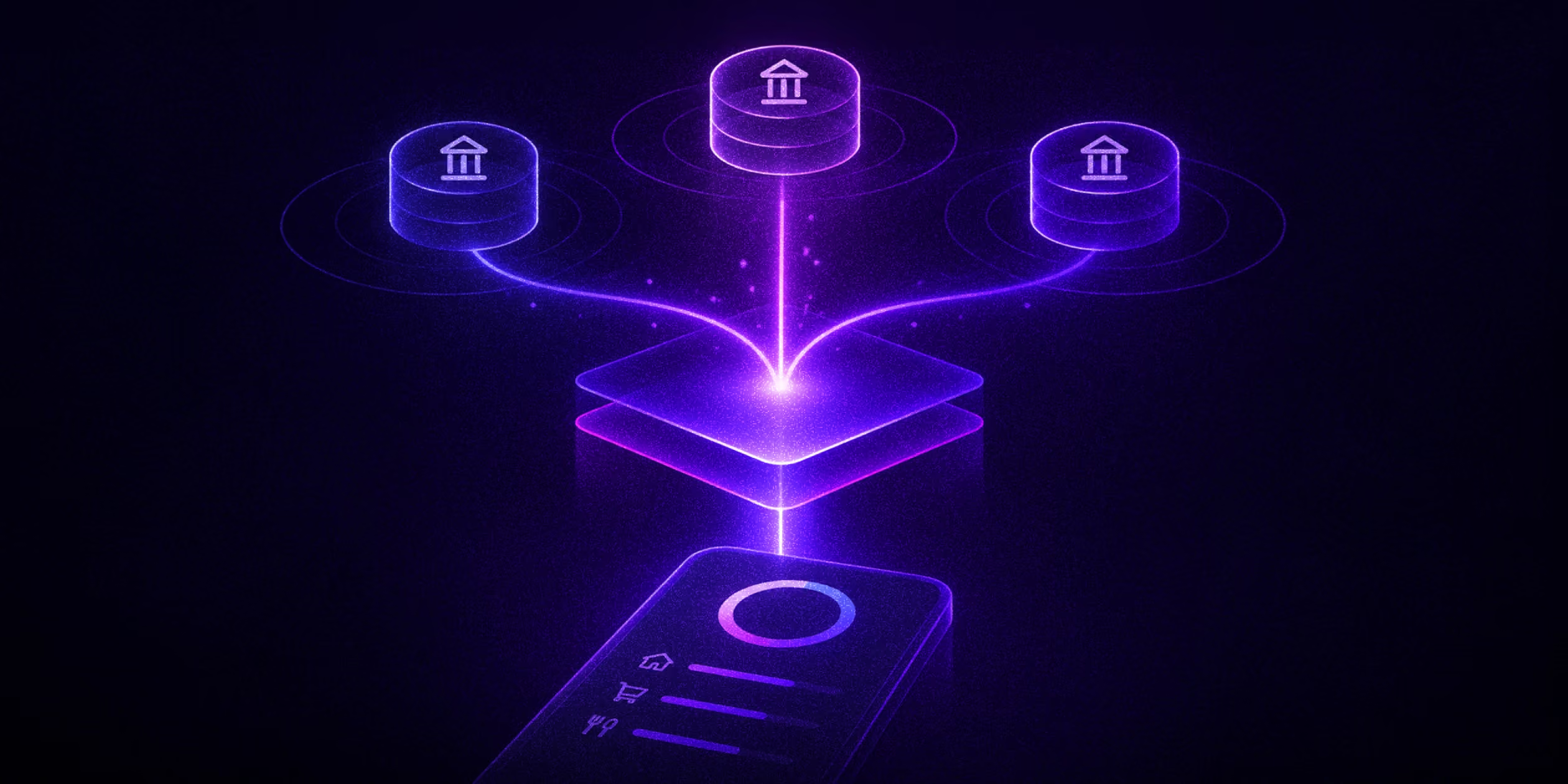
You can, but it is an ongoing commitment, not a one-time project. You would need to integrate and maintain several aggregators, normalize their different data models, monitor connection quality bank by bank, and adjust routes whenever an institution changes its login flow or access rules. Quiltt takes on that work, routing connections across multiple aggregators through one normalized API. Learn how account aggregation works at Quiltt.
Why does adding a second bank aggregator require rebuilding existing code rather than extending it?
An application built around a single aggregator encodes that provider's data model throughout the codebase: in the schema, the connection flow, and the error handling. Adding a second provider introduces a second data model that has to be reconciled at every point the first one was assumed. A normalization layer has to sit above both so the rest of the application sees one consistent shape. Without it, every downstream component (the frontend, the models, the webhooks) has to be updated to handle provider-specific variations. What looked like a deferred decision becomes technical debt distributed across the codebase, surfacing at exactly the moment the team is under pressure to fix a coverage gap.
Why do regional banks and credit unions create coverage problems for single-aggregator personal finance apps?
Major aggregators tend to prioritize large national banks, where user volume justifies the integration and maintenance cost. Regional banks and credit unions are less consistently supported; they may connect on one provider but not another, or they may connect unreliably even when listed as supported. Personal finance apps don't get to choose which institutions their users bank at, so coverage gaps directly cap the addressable user base. A user whose credit union isn't supported doesn't see a degraded experience. They see a dead end at the moment they try to link their account.