.avif)

Blog
7 Reasons Your Customers Can’t Connect Their Bank Account
TL;DR
- Bank connection failures are structural, not random. Token expiry, institution outages, rate limits, and stale states are the predictable cost for a single provider path into a bank.
- Single-aggregator architectures amplify every one of these. When the only provider degrades, your onboarding degrades with it.
- Multi-aggregator routing shortens how long user re-auth takes by sending the retry to a provider with a live path to the institution.
- Quiltt sees these patterns across thousands of connections and multiple aggregators, which is where the failure modes below come from.
Why bank connections fail more than they should
The failures fintech engineers hit in production are not edge cases. They are the predictable cost of depending on a single provider path into financial institutions. Every aggregator has banks it covers poorly, maintenance windows it does not control, and token pipelines that break for reasons no error code explains. When you route every connection through one of them, you inherit all of those weaknesses at once.
Quiltt routes across multiple aggregators, including Mastercard Open Finance (Finicity), MX, and Akoya, and that vantage across thousands of connections surfaces patterns no single-provider team can see. When the same institution succeeds through one aggregator and fails through another, the failure stops looking like bad luck and starts looking like a routing decision.
The 7 failure modes
Each failure below shows up in production for the same structural reason. Your app depends on a single path into an institution, and that path breaks in a predictable way.
- OAuth token expiry and re-auth friction
Tokens expire whether or not anyone touches the connection. Aggregators issue short-lived OAuth tokens that an institution can revoke at any time, and most pipelines give you little or no proactive signal that a token has gone stale. The connection reads as healthy in your own app until the next data pull returns nothing.
Your user feels this as a connection that worked yesterday and is now empty. Their balances stop updating, a transaction feed goes quiet, or an onboarding flow they already finished asks them to start over. Most users read that as your product breaking, not the bank rotating a token, and a meaningful share of them abandon rather than re-authenticate.
Two things reduce the drop-off. The first is catching the failure the moment a sync breaks, not when the user next opens your app. Quiltt flips the connection to an error status and fires a webhook the moment a sync fails, so you can prompt for re-auth, and provide context about why, instead of surfacing an empty screen. The second is having a second path when one aggregator's token pipeline is degraded. Routing to the best-suited provider sends new and reconnecting users to a provider whose token flow for that institution is live, rather than retrying the broken one.
Quiltt Connector handles the OAuth Reconnect Flow natively across web and mobile SDKs, and it routes each user to the provider with the better auth path for their specific bank. When one aggregator's tokens are failing for an institution, the connection still completes through another. The user re-authenticates once, through a flow that returns a stable connectionId, instead of fighting a token pipeline that has already gone dark.
- Institution-level outages with no fallback
A provider's status page can show all green while a specific bank behind that provider is unreachable. Aggregators connect to thousands of institutions, and each bank runs its own maintenance windows, API changes, and connectivity quirks. When a single bank goes dark on your provider, the dashboard stays green and your onboarding flow still breaks for every user trying to link that institution.
The user experience is unforgiving. Someone enters their credentials, waits through a spinner, and hits a generic error with no explanation. They don't know the bank is in a maintenance window. They assume your product is broken, and many abandon onboarding entirely. With one provider path, you have no answer except to ask them to try again later.
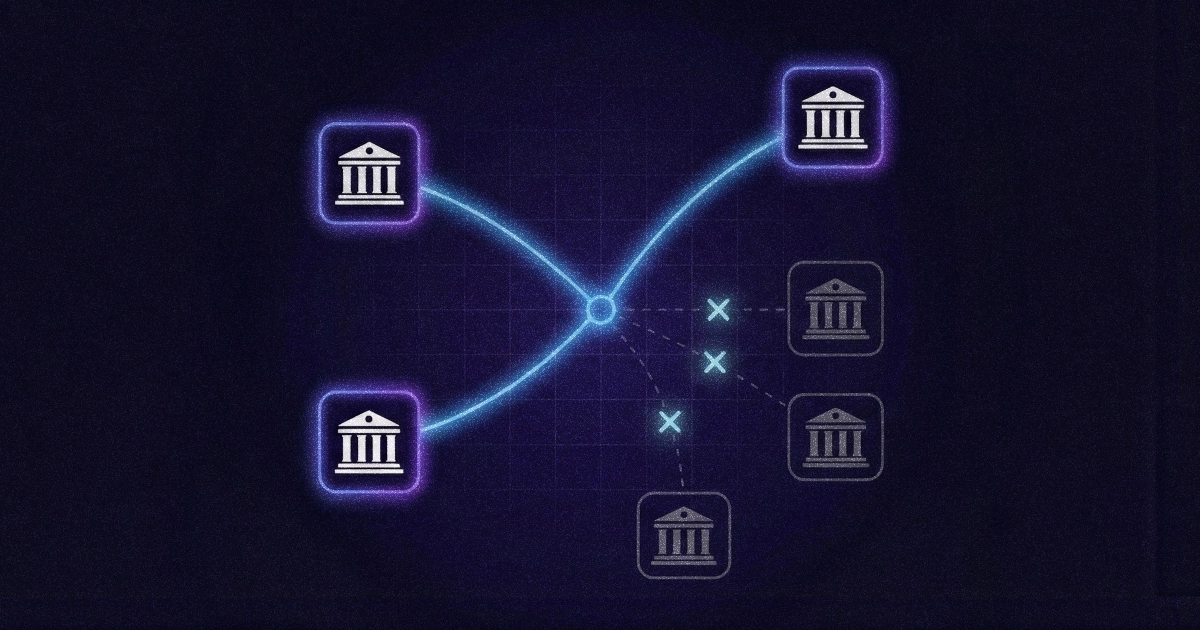
Quiltt routes around this by evaluating provider health at connect time and sending new connections to a provider with a live link to that institution. When MX can't reach a bank, Mastercard Open Finance (Finicity) or Akoya often can, and Quiltt selects the working provider when the connection is created. Circuit-breaker logic makes the difference at scale. Without it, every request to the dead provider waits out a full timeout before retrying elsewhere, which cascades into slow responses across your whole flow. The breaker trips open after a failure threshold and skips the unhealthy provider, so a single bank outage stays contained instead of degrading onboarding for everyone.
- Rate limit vary by provider
Every aggregator enforces its own API quotas, and those limits differ from provider to provider. When one gets exhausted, new account links can stall, which shows up to users as a failed connection or an abandoned signup, not as an obvious "rate limit" error.
Because Quiltt sits across multiple aggregators, you're not tied to any single provider's quota. A connection can draw on whichever provider has capacity instead of waiting on one that's currently limited. The result is that you stop managing provider-specific rate limits yourself. Quiltt handles that underneath.
- Stale connection states
Your database says a connection is healthy. The user's bank revoked access three days ago, and nobody told your system. That gap between recorded status and real status is the quietest failure on this list because nothing throws an error. The connection just stops returning fresh data, and your product keeps serving the last successful pull as if it were current.
The cause is missing or delayed status signals from the provider, combined with no loop that reconciles what you stored against what is actually true. Providers don't always emit an event when a connection drops, and when they do, the event can arrive late or get lost. If your only source of truth is the status field you wrote during the last sync, you inherit every gap in the provider's reporting.
The fix is an event-driven sync backed by an internal data store, so your application reads from your record rather than guessing from the last API call. Run health checks and synthetic pings on a fixed interval to catch silent drops before a user reports missing transactions. Reconcile state from webhooks as they arrive, and treat each one as a correction to your stored status.
Quiltt's Connections product area and webhook layer give you a single status signal across Mastercard Open Finance (Finicity), MX, and Akoya, so you reconcile against one normalized source instead of polling each aggregator separately.
- Credential-based auth deprecation
For years, aggregators reached most banks by storing a user's credentials and logging in on their behalf to scrape data. Banks are killing that path. They are sunsetting screen-scraping in favor of direct APIs with token-based OAuth, partly because credential sharing violates their terms of service and partly because batch scraping created data freshness problems. When an institution drops credential support, every connection your provider built on that method breaks at once.
The failure rarely announces itself cleanly. Your aggregator may keep the institution listed, but logins start failing or returning empty data because the scraping path no longer works and the provider hasn't shipped OAuth coverage for that bank yet. Coverage lags are worst for long-tail institutions, where a single provider may take months to build a direct API integration that a larger competitor already supports.
Routing across multiple aggregators turns a hard deprecation into a routing decision. When one provider has only the dying credential path for a given bank and another has the live OAuth path, Quiltt sends users to the provider with the working auth method instead of failing the connection. Because Quiltt routes to the best provider per institution, a single bank's migration to OAuth becomes a configuration change rather than a queue of broken connections you reconnect by hand.
- Data normalization mismatches across providers
Mastercard Open Finance (Finicity), MX, Akoya, and Plaid each return a different shape for the same account. One labels a checking account depository, another calls it checking, and a third nests the type two levels deep under a vendor-specific code. Transaction categories diverge even further, since each provider runs its own enrichment model with its own taxonomy. When your application reads these payloads directly, every routing decision you make couples your business logic to one provider's field names.
That coupling breaks the moment you add a second aggregator. Code that switched on Plaid's category strings silently miscategorizes everything coming from MX, and a budgeting feature that worked in testing starts mislabeling rent as entertainment in production. The bug surfaces downstream, far from the integration code, which makes it slow to trace and easy to ship.
The fix is a unified internal model that standardizes account types, currency codes, transaction fields, and institution identifiers before any of it reaches your app. Versioning that schema so a provider-side change adds a v2 field instead of breaking every consumer reading v1. Quiltt normalizes across Mastercard Open Finance (Finicity), MX, and Akoya at the connection layer, so your application reads one consistent schema regardless of which provider served the data. You write your logic once, and adding an aggregator never rewrites it.
- Webhook delivery failures
A missed webhook doesn't show up as an error. It shows up as a connection your system believes is healthy while the account behind it has gone dark. Providers offer no universal retry guarantee, so a delivery gap on their side or a brief failure in your own consumer means an event simply never arrives. Your UI keeps showing fresh balances, your re-auth trigger never fires, and the customer discovers the problem before you do.
That silent gap compounds every other failure mode in this list. A token expires, the provider emits a disconnection event, the event drops, and now your stale-state and re-auth handling never run. One lost message turns a recoverable problem into a data-quality incident that surfaces days later.
Three defenses work together. Build idempotent consumers so a retried or duplicated event never corrupts state. Run reconciliation polling on a fixed interval as a safety net for events that never arrive. Treat webhooks as the fast path and polling as the floor, never as the only signal.
Quiltt normalizes webhook events across Mastercard Open Finance (Finicity), MX, and Akoya into one event format, so you write a single consumer instead of reconciling each provider's delivery quirks and payload shapes. You handle the event, not the provider that sent it.
How to think about routing before the failures happen
Route on metrics or you're routing on guesses. Every failure mode covered above produces a signal you can measure, and the teams that handle them well decide their routing logic at design time, not during an incident at 2am.
Three metrics carry most of the decision. Fallback trigger rate tells you how often your primary path fails, and a sustained reading above roughly 5% means your primary provider has a problem worth investigating, not a blip. Success rate by chain position tells you whether your primary is even the right primary. When your first fallback succeeds far more often than your primary for a given institution, you chose the wrong default for that bank. Per-provider latency, measured at the routing layer rather than the provider's own dashboard, catches the degradation cases where a provider responds but too slowly to be usable.
A backup provider that hasn't taken real production traffic in months is a guess, not a backup, as the Cisco ThousandEyes post-mortem on the October 2025 AWS outage put it. Validate fallback paths under load before you need them, and instrument the routing layer so the next failure is a dashboard line you already watch.
Start with a connection layer that handles this for you
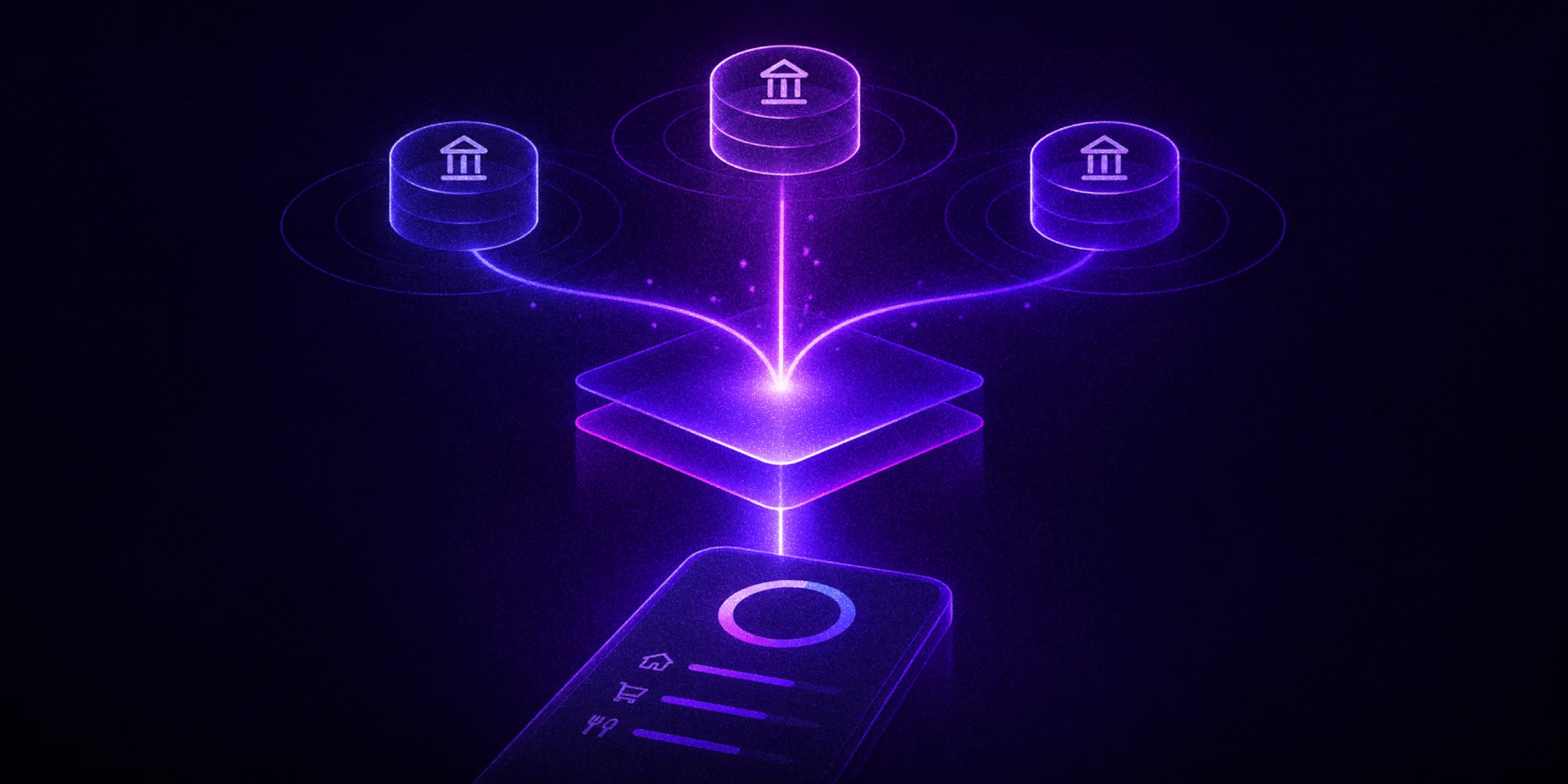
Every failure mode above shares one root cause, which is depending on a single path into each institution. Quiltt Connector removes that dependency by routing each user to the best provider for their bank, normalizing data across Mastercard Open Finance (Finicity), MX, and Akoya, and handling OAuth re-auth flows inside its embeddable UI. You sign one contract, write no aggregator-specific integration code, and toggle providers on or off from the dashboard when you want to add a fallback path.
The Crew team used this to reach 2,000-plus institutions in two weeks. Read the developer docs to see how the SDKs, webhooks, and connection state model fit your stack.
Frequently Asked Questions
Can I start with one provider and add more later?
Absolutely. Many of our customers start with a single provider and expand their provider network as their needs evolve. If you're on the Startup plan or above, you can easily enable additional providers through the Quiltt Dashboard at any time. There's no need to integrate new code or negotiate additional contracts - just toggle on the providers you want to use. If you're on our builder plan, send an email to sales@quiltt.io and we can set you up with one of our higher tiers!
Do I need my own API keys from the data providers?
No, you don't need to obtain your own API keys. Quiltt securely manages the necessary API keys and credentials on your behalf, simplifying the integration process. However, if you already have your own API keys, you can easily configure Quiltt to use them instead.
Do I need separate contracts with each data provider?
No - that's one of the key benefits of working with Quiltt. As an authorized reseller of leading data providers, we offer wholesale pricing and manage all vendor relationships on your behalf through a single agreement. This means you get competitive rates and don't have to deal with the complexity of managing multiple vendor relationships, contracts, and billing cycles.
Why is orchestration so important for B2B fintech apps?
An orchestration platform routes connection requests across multiple bank data aggregators through a single integration, allowing fintech apps to get broader bank coverage and automatic failover between providers. No single aggregator has anywhere close to full coverage of the commercial banking stack, making using multiple providers essential.