

Blog
Why Top Personal Finance Apps Made This Infra Choice
Starting with Plaid makes sense. The docs are pretty good. The API is fairly clean. Coverage across major US financial institutions is solid. A team that's never worked with bank connections before can get one working in a couple of sprints.
For a team needing to launch their consumer budgeting app, the choice seems straightforward. Everyone says that getting to market as fast as possible matters more than architectural perfection when you're pre-revenue. Bank connections work in the sandbox, so you ship and move on to the next problem.
Multi-aggregator sounds complex, but is it?
The case for adding a second aggregator exists from day one. Most builders simply put it off for a later upgrade.
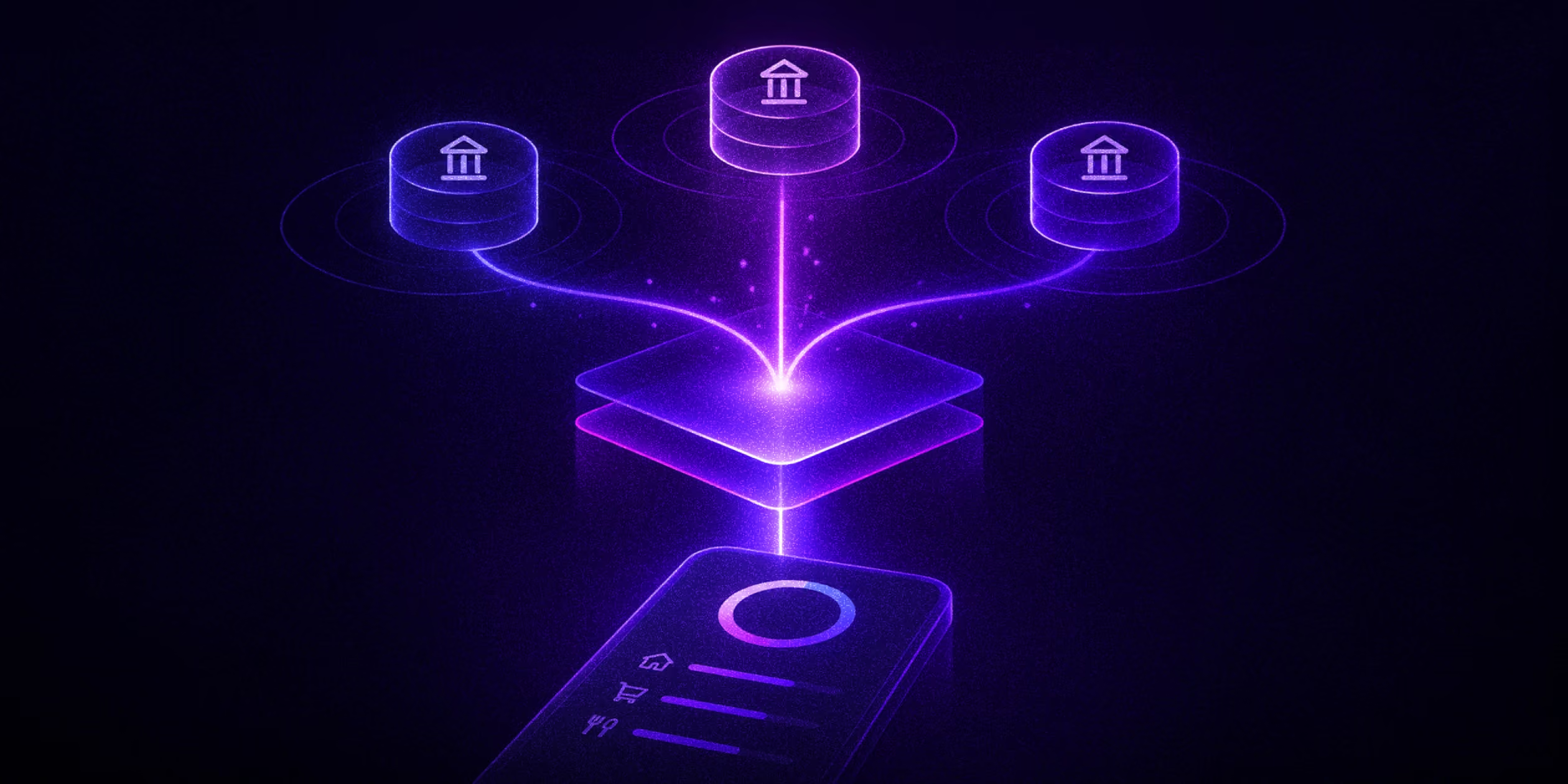
Multiple aggregators means multiple contracts, multiple integrations, and multiple mental models. Each provider has its own API schema, its own per-institution quirks, and its own logic for how a connection succeeds or fails. Stitching them together isn't just additive work. You need routing logic to pick the right provider for each institution, failover flows when a connection degrades, and a normalization layer so your frontend and models see one data shape instead of three.
It sounds like a lot of unnecessary engineering work, optimizing the infrastructure prematurely when your focus is on getting customer validation. Multi-aggregator becomes a later problem. Most teams log it and move on.
Single-aggregator flaws show up right away
The catch is that "later" arrives with the first users who try to link a bank you can't reach.
Single-aggregator coverage can be wide, but is inherently incomplete. No matter how much due diligence you do, you don’t get to choose your customers, the banks they use, or the institutions your chosen aggregator plays nice with. Credit unions and regional or local banks don’t all have the same support from your chosen aggregator, but they have something else you want: potential customers. Beyond that, many more accounts may technically connect, but if they haven’t synced reliably in days, the whole experience you promised in your app is seriously degraded.
Read the one-star reviews for the top budgeting apps. The complaints are rarely about the budgeting effectiveness. They're about delayed, broken, or missing bank connections - table stakes for any app that handles someone’s finances.
EveryDollar publishes its own list of institutions with limited or broken connectivity. YNAB users describe some major banks never updating, and some have resorted to cobbling together their own systems to reach banks the app can't. These reviews get written before the product is experienced, at the exact moment someone tries to link the account they actually use.
What fixing it actually requires
Adding a second aggregator is the beginning of the work, not the end of it.
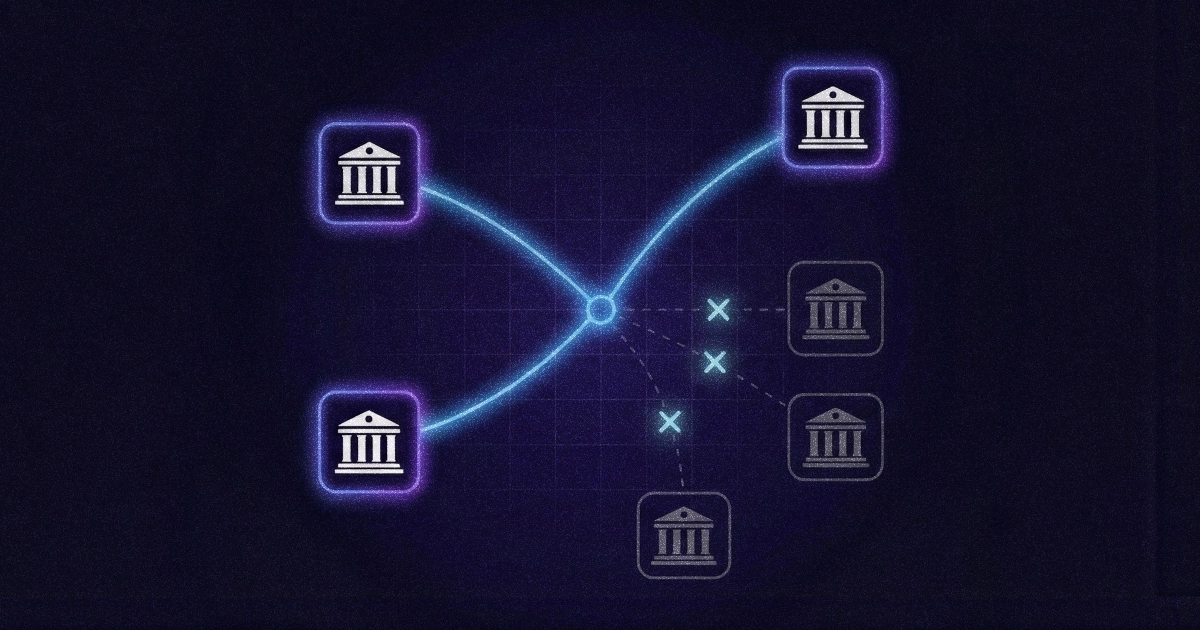
Routing logic determines which provider handles each institution. Failover routes the request somewhere else when a provider's connection degrades. A normalization layer sits above both so your application doesn't rebuild its output handling every time a provider changes behavior. Each of those systems requires ongoing maintenance as aggregators update APIs, add institutions, and modify their connection flows.
This is also where the cost of the initial simplicity decision starts to show up. The connection architecture your product was built around was designed for one provider. Adding a second means auditing that infrastructure and potentially rebuilding parts of it from the ground up, not extending it. The schema, the connection flow, the error handling: all of it was built with one data model in mind. What looked like a deferred decision turns out to be technical debt distributed across the codebase, and it becomes apparent at the worst time, when the team is already under pressure to ship fixes for the coverage gap that surfaced it.
The right architecture that makes multiple aggregators work
Multi-aggregator is necessary but it isn't sufficient on its own.
Teams that stitch multiple providers together in-house face the same operational overhead as the problem they were trying to solve, just distributed across more contracts and more provider-specific quirks. Someone is still writing and maintaining the routing logic, still absorbing the normalization work. The coverage improves, but the engineering burden doesn't disappear.
Monarch and Copilot built multi-aggregator orchestration in-house because they had the headcount and expertise to staff it from the early days. Monarch routes connections across Mastercard Open Banking (Finicity), MX, and Plaid, and its help center teaches users to switch providers when one fails. Copilot added MX, Finicity, and Akoya underneath its connection flow over time. Both now collect the five-star ratings that follow reliable connectivity, and reviewers rate Copilot's transaction data quality among the best in the category.
Most fintech teams are not Monarch or Copilot.
Quiltt makes a normalized data schema for all major aggregators available through a single API integration. Quiltt handles provider routing and failover and normalizes the data underneath, so the app sees one schema regardless of which provider handled the connection. For teams using Quiltt's resold providers, there's one contract to sign instead of several. Teams that bring their own Plaid relationship can connect their key directly.
The integration architecture doesn't change and the orchestration doesn't need to be staffed.
Dollarwise learned this the hard way
Dollarwise, the budgeting app Caleb Hammer built for his 3.69M+ audience, launched its first version on a single aggregator. Any unsupported institution or outage was a dead end at the exact moment a new user tried to link a bank. Early reviews said so, loudly.
For the rebuild, the Dollarwise team went multi-aggregator through Quiltt rather than standing up their own orchestration layer. Finicity, MX, and Plaid all surface through one connection point. Quiltt handles the provider routing and failover and normalizes the data underneath. Their integration architecture didn't change.
At the launch of their multi-aggregator version, thousands of new signups pushed through in minutes. Initial account sync held under 10 seconds through the spike. Institution coverage nearly doubled to 21,000 bank portals, and bank link conversion at onboarding lifted by as much as 25%.
One YouTube reviewer's updated verdict: automatic transaction importing is "the whole reason that the app actually works now." Dollarwise engineers had their decision validated.
The scoreboard is public
Open the app store and look at the reviews yourself. Check out Reddit. Many of the complaints trace back to a single point of failure between an app and the thousands of banks its customers use. When account connection, synced transactions, and enriched data is central to how a personal finance app functions, you should be confident that customers will get all of that on day one. And every day after that.
A unified API gives any team the architecture the category leaders built for themselves: one integration, multiple aggregators behind it, routing and failover handled. The entire product decision around how you handle coverage and connectivity becomes a no-brainer.
Frequently Asked Questions
Why do the most-reviewed personal finance apps consistently get so many complaints about bank connections?
The most common complaint in one-star reviews of budgeting and personal finance apps isn't about features. It's about bank connections that fail, lag, or never sync. Apps like YNAB and EveryDollar have publicly documented lists of institutions with limited or broken connectivity. The budgeting logic gets evaluated after the bank link works; when it doesn't, the user never gets that far. Connection reliability is the prerequisite for everything else the product does. Read more about what causes bank connection failures.
What is bank link conversion rate and why does it matter when onboarding?
Bank link conversion is the percentage of users who successfully connect a bank account during onboarding. A failed connection at that moment typically ends the session permanently; users rarely return to retry. Coverage gaps, institution-specific errors, and single-aggregator limitations all suppress this number. Dollarwise saw bank link conversion lift by as much as 25% after moving to multi-aggregator routing through Quiltt.
Should we build institution-level routing in-house?
You can, but it is an ongoing commitment, not a one-time project. You would need to integrate and maintain several aggregators, normalize their different data models, monitor connection quality bank by bank, and adjust routes whenever an institution changes its login flow or access rules. Quiltt takes on that work, routing connections across multiple aggregators through one normalized API. Learn how account aggregation works at Quiltt.
What is failover in bank connectivity and when does it matter?
Failover is the ability to automatically reroute a connection attempt when a provider is degraded or unavailable for a specific institution. Individual aggregators experience outages, rate-limiting events, and institution-specific failures that are not predictable in advance. Without failover, those events become user-facing errors. With it, the connection reroutes to a working provider and the user sees a successful link. For personal finance apps, a failed connection at onboarding is a lost user. Failover is a retention mechanism.
Why does adding a second bank aggregator require rebuilding existing code rather than extending it?
An application built around a single aggregator encodes that provider's data model throughout the codebase: in the schema, the connection flow, and the error handling. Adding a second provider introduces a second data model that has to be reconciled at every point the first one was assumed. A normalization layer has to sit above both so the rest of the application sees one consistent shape. Without it, every downstream component (the frontend, the models, the webhooks) has to be updated to handle provider-specific variations. What looked like a deferred decision becomes technical debt distributed across the codebase, surfacing at exactly the moment the team is under pressure to fix a coverage gap.
Which personal finance apps use multi-aggregator architecture?
Monarch Money and Copilot are the clearest examples in the consumer PFM category. Monarch routes connections across Mastercard Open Banking (Finicity), MX, and Plaid, and its help center explicitly guides users to switch providers when one fails. Copilot added MX, Finicity, and Akoya over time and is now rated among the top apps for transaction data quality. Both companies built and staffed their own orchestration layers. For teams without that headcount, Quiltt provides the same multi-aggregator architecture through a single integration and contract, routing across Finicity, MX, and Plaid.
Why do regional banks and credit unions create coverage problems for single-aggregator personal finance apps?
Major aggregators tend to prioritize large national banks, where user volume justifies the integration and maintenance cost. Regional banks and credit unions are less consistently supported; they may connect on one provider but not another, or they may connect unreliably even when listed as supported. Personal finance apps don't get to choose which institutions their users bank at, so coverage gaps directly cap the addressable user base. A user whose credit union isn't supported doesn't see a degraded experience. They see a dead end at the moment they try to link their account.
.avif)