

Blog
Your bank connection failed. Switching aggregators may not fix it.
TL;DR
- When a bank connection fails, the problem may not be an unreliable aggregator. Sometimes, the aggregator has a weak connection at one particular institution.
- Connectivity is determined institution by institution. Banks control their authentication flows, API policies, and third-party access rules, and they change them on their own schedules.
- No aggregator is strongest everywhere. Switching one provider for another is a tradeoff that might fill some gaps and introduce others, depending on your needs.
- Institution-level failures call for institution-level routing, which is possible with a multiaggregator approach. Route each institution to the provider with the strongest available connection, without forcing your entire user base through a migration.
- Consider a unified API like Quiltt to make multiaggregator architecture easier for your developers and connectivity better for your customers.
A customer opens your app.
They choose their bank. Enter their credentials. Complete MFA.
Then...nothing.
The connection spins, stalls, and dies. So they try again. Same result.
Then they do what frustrated customers do: they blame your product and open a support ticket.
Your team blames the aggregator.
That conclusion feels obvious. It may also be wrong, because when bank connectivity breaks, the problem is often not that your aggregator is broadly unreliable. The aggregator likely has a weak connection at one particular institution.
One diagnosis leads to a costly migration. The other leads to better routing.
The institution is the culprit
Imagine a personal finance app that relies on one aggregator.
Most connections work. Then complaints begin arriving from customers at a large regional bank. Support tickets get filed. Engineers investigate. The aggregator says the issue is being reviewed.
A week later, balances at a credit union stop refreshing. At the same time, customers banking with Chase, Wells Fargo, and Bank of America keep connecting without a problem.
The aggregator looks inconsistent. Because it is.
But replacing it may simply rearrange the failures.
The new provider might perform better at that regional bank and worse at three others. The banks change, but the pattern remains.
That's because connectivity is determined institution by institution.
Banks control their authentication flows, API policies, third-party access rules, and technical infrastructure. They change those systems on their own schedules occasionally with little warning.
When a bank changes its login flow, credential-based connections can break. When it limits API access to preferred providers, excluded aggregators lose connectivity regardless of how well they perform elsewhere.
The useful question is not “Is our aggregator good?”
It is “How good is this aggregator at the institutions our customers use?”
Coverage is not one map
No aggregator is strongest everywhere. Each one maintains a network of connections.
National banks with mature APIs tend to offer more stable OAuth connections across multiple providers. Regional banks are less predictable. Credit unions can be harder still, particularly when they rely on credential-based access.
Geography adds another fault line. An aggregator with excellent coverage across major US banks may struggle with Canadian credit unions or smaller institutions in underserved markets. Another provider may have stronger relationships there but weaker coverage somewhere else.
Then there is the access policy. Some institutions grant API access to only a limited group of providers. In those cases, technical competence is beside the point. If your aggregator is not invited to the party, it does not matter how nice its shoes are.
This is the structural reality of open banking: an aggregator can only use the access an institution makes available to it.
Switching aggregators trades one set of gaps for another
Sometimes switching is the right move. If another aggregator has a materially stronger connection at an institution critical to your customers, it may solve that problem. But, it rarely solves the category of problem.
Migrations carry real costs. Customers may need to reconnect their accounts. Support volume rises. Engineers must build and test the new integration while keeping the old one alive. Data models behave differently. Edge cases multiply.
And after all that work, you inherit a new coverage map, just with new gaps.
When every customer is routed through one aggregator, that provider network’s weaknesses become your weaknesses. Replacing it can raise reliability at some institutions while lowering it at others.
Route each institution to its strongest connection
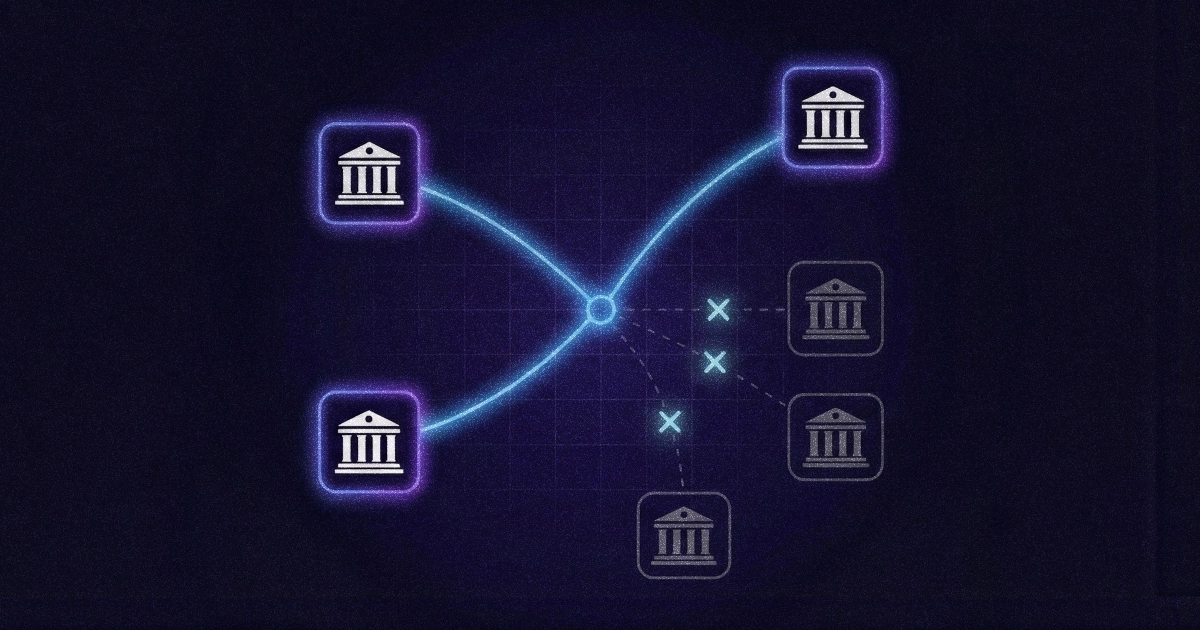
Institution-level failures call for institution-level routing. Instead of sending every customer through the same aggregator, route each institution to the provider with the strongest available connection.
One bank goes through Provider A. A regional credit union goes through Provider B. If a connection deteriorates, routing can change without forcing your entire user base through a migration.
For the customer, none of this should be visible. They select their bank, connect, and go on with their life.
Simple on the surface. Less so underneath.
Institution-level routing requires current performance data. It requires fallback logic, reconnect flows, and ongoing monitoring. Supporting several aggregators also means maintaining several integrations, normalizing different data models, and managing multiple commercial relationships.
And the work never really ends. A route that performs well today may need to change when a bank updates its authentication flow six months from now.
Someone has to own that complexity.
What this means for your product
If you are choosing your first aggregator, stop asking which one is “best.”
Ask which institutions matter most to your customers and which provider performs best at those institutions.
If you already have coverage problems, resist the urge to rip everything out.
First, identify exactly where connections are failing. Then compare the available providers at those institutions. A targeted routing change may solve the problem without subjecting every customer to a migration.
If you are building for scale, the decision becomes architectural:
Do you build and maintain multi-aggregator routing yourself, or use an orchestration layer that handles it?
Quiltt routes connections across multiple aggregators through one normalized API. That gives product teams institution-level routing without requiring them to build, normalize, and maintain the entire multi-provider layer themselves.
The goal is not to find one aggregator that wins everywhere. That aggregator does not exist.
The goal is to use the strongest available connection wherever your customer banks.
Frequently Asked Questions
Do all aggregators cover the same institutions?
No. Coverage and connection quality vary by institution, account type, geography, and access method. Even when a bank is listed as a covered institution, certain account types may not be available or can experience different connectivity levels.
Is a broken bank connection the aggregator’s fault?
Sometimes. But a failure at one bank does not necessarily mean the aggregator is unreliable everywhere. Banks control their authentication systems and access policies, making reliability highly institution-specific.
Should we switch aggregators when a bank stops connecting?
Not automatically. First, determine whether the problem is isolated to a particular institution and whether another provider has a stronger connection there. A full migration may replace one coverage gap with several new ones. A better option is to consider adding one or more aggregators to your application.
Why can one aggregator connect to a bank when another cannot?
Institutions may support different connection methods or grant API access to a limited set of providers. Relationships, access policies, and technical integrations vary by bank. The aggregator's job is to maintain their network; your job is to maximize coverage without relying on a single aggregator network.
What is institution-level routing?
Institution-level routing means sending each bank connection through the aggregator best equipped to support that institution at that time, rather than sending every customer through a single provider.
Should we build institution-level routing in-house?
You can, but it is an ongoing commitment, not a one-time project. You would need to integrate and maintain several aggregators, normalize their different data models, monitor connection quality bank by bank, and adjust routes whenever an institution changes its login flow or access rules. Quiltt takes on that work, routing connections across multiple aggregators through one normalized API. Learn how account aggregation works at Quiltt.


.avif)