
Industry
What is a Financial Account Aggregator?
Today’s consumers interact with dozens of financial touchpoints. A single user might have to check an account with a legacy bank, a credit card from a neo-bank, and an investment account through an app.. For product teams building financial experiences, that fragmentation creates both a challenge and an opportunity. Users want one place to track their finances. They expect your app to show the full picture without the manual work. But stitching together data from all those sources is rarely straightforward.
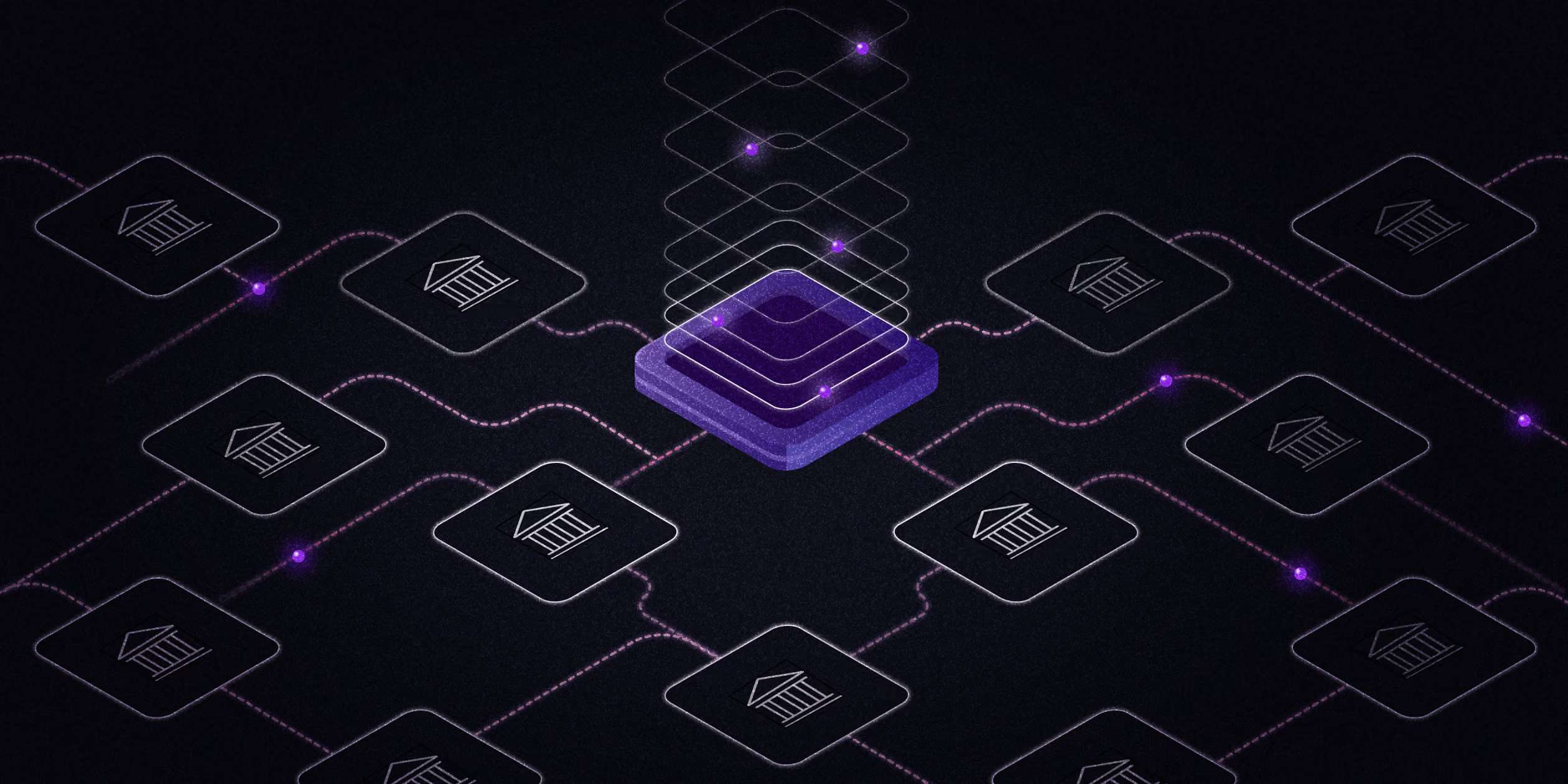
A financial account aggregator solves this. It creates a unified data layer by connecting disparate accounts into a single, normalized view. It’s the engine behind personal finance tools, credit monitoring dashboards, accounting software, and real-time payment authorization. But for developers, aggregation isn’t just about displaying numbers, it’s about enabling the features, insights, and decision logic that define the product itself.
What Is a Financial Account Aggregator?
Think of a financial account aggregator as your personal financial command center. Instead of juggling logins for your checking account, credit card, investment portfolio, and that savings account you opened last year, an aggregator pulls everything together in one place.
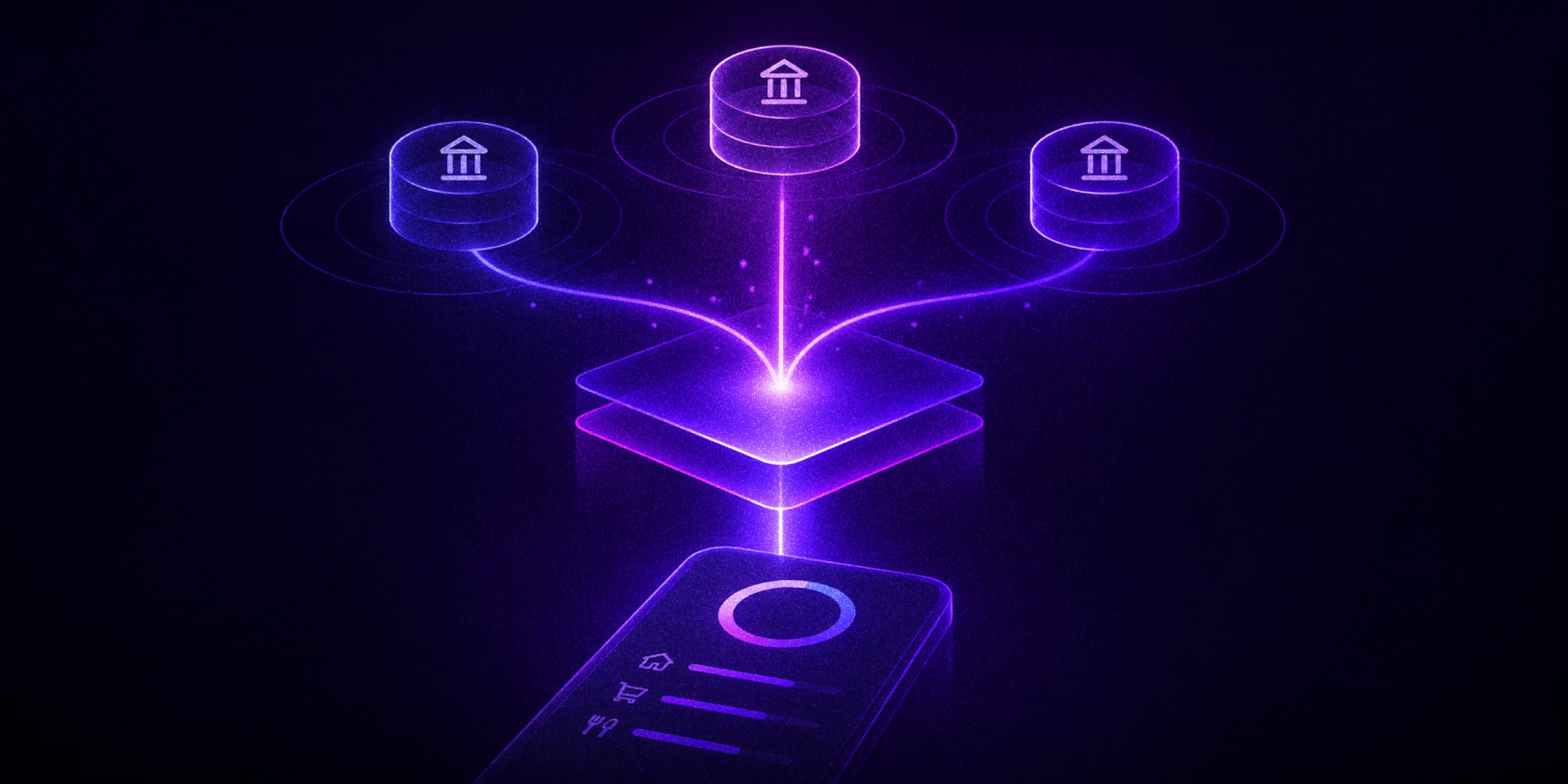
Here's how it works: you connect your various financial accounts to the aggregator platform, and it securely fetches your financial data from each financial institution. The result? A single dashboard where you can see your complete financial picture without the headache of remembering multiple passwords.
Account aggregation has come a long way since its early days of unreliable screen scraping. Modern services tap into bank account APIs and Open Banking infrastructure, creating rock-solid connections. This shift means account linking actually works consistently, something that wasn't always guaranteed with older systems.
The magic happens through secure authentication and data sharing protocols. You authenticate once with each bank or financial provider, and the aggregator handles the rest. No more opening five different apps just to figure out if you can afford that weekend trip.
How Does Account Aggregation Work?
The account aggregation process begins when users initiate account linking through an aggregator platform. The system prompts users to select their financial institutions from a comprehensive database that typically includes major banks, credit unions, investment firms, and other financial service providers.
Once users select their institutions, they provide authentication credentials through a secure interface. Modern account aggregation services employ multiple connection methods, including direct API connections, screen scraping, and Open Banking protocols, depending on the institution's technical capabilities.
Data aggregation occurs in real-time or near real-time, depending on the service and institution. The aggregator retrieves account balances, transaction histories, payment schedules, and other relevant financial data. This information is then normalized and presented through user-friendly interfaces that make it easy to understand and analyze.
Security measures are paramount throughout this process. Reputable aggregators use bank-level encryption, multi-factor authentication, and tokenization to protect sensitive information. Many services also employ read-only access, ensuring they cannot initiate transactions or make changes to account holders' financial accounts.
Key Benefits of Using a Financial Account Aggregator
Financial account aggregators offer numerous advantages for both consumers and financial advisors. The primary benefit is consolidated visibility across all financial accounts, which provides users with a complete picture of their financial situation without the hassle of managing multiple logins and platforms.
Budgeting and expense tracking become significantly more manageable with aggregated data. Users can categorize spending across all accounts, identify patterns, and make informed decisions about their financial habits. This comprehensive view is particularly valuable for achieving financial goals such as saving for major purchases or planning for retirement.
Time savings represent another significant advantage. Instead of logging into multiple banking platforms, users can access all their financial information through a single interface. This efficiency is especially beneficial for individuals with complex financial portfolios that include multiple bank accounts, credit cards, and investment accounts.
Financial advisors and wealth management professionals also benefit from account aggregation technology. Clients can easily share their complete financial picture, enabling more informed advice and better portfolio management strategies. This comprehensive data access facilitates more accurate financial planning and goal-setting discussions.
Potential Risks and Security Concerns
While financial account aggregators offer substantial benefits, users should be aware of potential risks and security measures. The primary concern involves sharing login credentials with third-party services, which some users find uncomfortable despite robust security protocols.
Data breaches represent a legitimate concern, although reputable aggregators implement comprehensive security frameworks to protect user information. These measures include encryption, secure data transmission, regular security audits, and compliance with financial industry regulations.
Account holders should also consider the implications of data sharing with aggregator services. While most reputable providers have strict privacy policies, users should understand how their financial information is stored, used, and potentially shared with other parties.
Technical issues can occasionally disrupt account linking functionality. When financial institutions update their systems or change authentication protocols, an account aggregation service may temporarily lose connectivity to certain accounts. These disruptions, while typically resolved quickly, can affect users who rely heavily on real-time financial data.
Who Should Use a Financial Aggregator?
Financial account aggregators are great for teams building data-driven financial products. If your application requires access to live or historical bank account data, normalized transaction feeds, or unified views of user finances, aggregation is essential infrastructure.
Developers building personal finance management tools, neobank interfaces, embedded lending flows, or underwriting models all rely on aggregators to deliver consistent, structured data across a wide range of financial institutions. Without aggregation, those workflows would require dozens of manual integrations or force users to input data themselves, something most modern users won’t tolerate.
Founders, engineers, and product managers working on B2B or B2C FinTech platforms benefit from aggregation by unlocking faster time-to-market, reduced technical debt, and scalable data architecture. Suppose you are launching a new savings product or expanding into SMB lending. In that case, account aggregation provides the visibility and data fidelity necessary to deliver smarter, faster, and more responsive financial experiences.
Choosing the Right Aggregator
Selecting an appropriate financial account aggregator requires careful consideration of several factors. Security measures should be the primary concern, with users prioritizing services that employ bank-level encryption, multi-factor authentication, and comprehensive privacy policies.
Institution coverage represents another crucial factor. The best aggregators support connections to thousands of financial institutions, including major banks, credit unions, investment firms, and alternative financial service providers. This broad coverage ensures users can link all their relevant accounts.
User interface and experience quality significantly impact the value derived from aggregation services. Look for platforms that present financial data clearly, offer robust categorization and analysis tools, and provide intuitive navigation across different account types and features.
For fintech builders, API availability and integration capabilities are essential considerations. The most effective bank account API and account aggregation services offer robust developer tools, comprehensive documentation, and flexible integration options that support various application architectures.
Future of Account Aggregation and Open Banking
The account aggregation sector continues to evolve rapidly, driven by Open Banking initiatives and advancements in financial technology. Open Banking standards are creating more standardized and secure methods for financial data sharing, reducing reliance on screen scraping and credential-based connections.
Artificial intelligence and machine learning technologies are enhancing aggregation services with predictive analytics, automated categorization, and personalized financial insights. These advances help users better understand their spending patterns and make more informed financial decisions.
Data aggregation capabilities are expanding beyond traditional banking products to include alternative financial services and emerging payment platforms. This broader scope provides users with increasingly comprehensive views of their financial ecosystems.
Regulatory developments continue shaping the account aggregation industry, with new rules addressing data sharing practices, consumer protection, and financial privacy. These regulations generally strengthen security measures and provide consumers with greater control over their financial information.
The integration of account aggregation technology into broader financial services platforms is accelerating. Banks, investment firms, and fintech companies are incorporating aggregation capabilities directly into their offerings, creating more seamless user experiences.
To Wrap Up
Financial account aggregators have become essential tools for managing complex financial lives in the digital age. These services provide consolidated visibility across multiple financial institutions, enabling better financial decision-making and goal achievement. While users should carefully consider security measures and privacy implications, the benefits of comprehensive financial oversight typically outweigh the risks.
For fintech builders developing financial applications, understanding account aggregation technology and bank account APIs is crucial for creating competitive products. The future of Open Banking and data aggregation promises even more powerful tools for financial management and analysis.
As financial services continue evolving, financial account aggregators will play increasingly important roles in helping consumers and businesses navigate their financial complexities. Choosing the right aggregation service requires careful evaluation of security, coverage, usability, and integration capabilities.
Financial Data Aggregation vs. Account Aggregation
These terms get used interchangeably and the overlap is real, but the difference is worth pinning down because it maps onto two different buying decisions.
Account aggregation is about connection and coverage: can you reliably link a user's accounts across banks, credit unions, brokerages, and card issuers, and keep those connections alive? The hard problems are institution coverage, authentication flows, and connection durability.
Financial data aggregation is the broader pipeline — collecting the raw data, then normalizing it into a consistent schema and enriching it with categorization, merchant identification, and derived signals like income or recurring payments. Two aggregators can both return a transaction feed while giving you wildly different data quality.
The reason this matters: most teams evaluate aggregators on coverage alone, then discover that the normalization and enrichment layer is where the engineering months actually go. A single connection that returns clean, categorized, consistently-shaped data is worth more than three that return raw feeds you have to reconcile yourself.
Frequently Asked Questions
What exactly does a financial account aggregator do?
A financial account aggregator connects to various financial institutions and retrieves data like balances, transactions, account metadata, and more. It delivers this information through a unified API, allowing your FinTech app to access real-time and historical data without managing dozens of individual integrations.
Why wouldn’t I just build direct integrations with each financial institution?
Building one-off integrations with banks or financial institutions is technically complex and resource-intensive. APIs vary significantly in terms of reliability, formatting, and security standards. Aggregators help solve that by offering normalized, consistent data through a single API.
If you want access to multiple providers for broader coverage or redundancy, you’ll typically need to negotiate individual contracts with each one. That adds legal, procurement, and compliance complexity to your development process.
Quiltt solves both layers of friction. You get a single integration and a single contract that unlocks access to multiple financial aggregators, so your team can move faster without getting buried in technical or legal hurdles.
Building one-off integrations with each bank, credit union, or investment platform is time-consuming and costly. APIs vary widely in format and reliability. Aggregators standardize that complexity, offering normalized data through one interface so your team can ship faster and maintain less over time.
What types of financial accounts can typically be aggregated?
Most financial aggregators support a wide range of accounts including checking, savings, credit cards, loans, mortgages, and brokerage accounts. Depending on the provider, support may also extend to business accounts and tax-advantaged savings accounts.
Is Open Banking required for aggregation to work?
Open Banking improves aggregation by providing secure, token-based access and standardized APIs. But in the U.S., where Open Banking adoption is still uneven, most aggregators use a hybrid approach combining Open Banking APIs, credential-based access, and fallback methods like screen scraping.
What are common use cases for aggregation in FinTech products?
Aggregation powers features like personal finance dashboards, income verification, credit modeling, cash flow analysis, and lending decisions. It also enables smoother onboarding and faster user activation by reducing manual data entry.
How often is financial data refreshed?
Refresh rates depend on the aggregator and the type of institution. Some APIs offer near real-time updates, while others may refresh once or twice daily. For time-sensitive workflows like lending or fraud detection, it’s important to choose a provider that prioritizes low latency and consistent syncs.
What should I consider when evaluating aggregators for my product?
Key factors include breadth of institutional coverage, data accuracy, refresh frequency, developer experience, support SLAs, compliance posture, and pricing flexibility. Testing in a sandbox and reviewing real-world sync reliability is also critical before committing.
Does using an aggregator introduce compliance risks?
Using a trusted financial account aggregator can help you stay compliant, especially if they support tokenized access, consent tracking, and audit trails. However, your app still needs to handle data responsibly, disclose usage in your privacy policy, and offer users the ability to revoke access.
What is a data aggregator?
A data aggregator is a service that collects information from multiple independent sources and delivers it through a single interface. The term is used across many industries; in financial services it refers specifically to platforms that connect to banks and other institutions to retrieve customer-permissioned account data — balances, transactions, account metadata, and identity details — and return it in a consistent format.
What does it mean to aggregate bank accounts?
Aggregating bank accounts means connecting several accounts held at different institutions so their data can be viewed and processed together. The user authenticates with each institution once and grants permission; from then on the aggregator retrieves data on their behalf. This is what lets a budgeting app show a complete financial picture, or a lender assess cash flow across every account a borrower holds rather than the one they volunteered.
Frequently Asked Questions
What is a data aggregator?
A data aggregator is a service that collects information from multiple independent sources and delivers it through a single interface. The term is used across many industries; in financial services it refers specifically to platforms that connect to banks and other institutions to retrieve customer-permissioned account data — balances, transactions, account metadata, and identity details — and return it in a consistent format.
What exactly does a financial account aggregator do?
A financial account aggregator connects to various financial institutions and retrieves data like balances, transactions, account metadata, and more. It delivers this information through a unified API, allowing your FinTech app to access real-time and historical data without managing dozens of individual integrations.
What does it mean to aggregate bank accounts?
Aggregating bank accounts means connecting several accounts held at different institutions so their data can be viewed and processed together. The user authenticates with each institution once and grants permission; from then on the aggregator retrieves data on their behalf. This is what lets a budgeting app show a complete financial picture, or a lender assess cash flow across every account a borrower holds rather than the one they volunteered.