
.avif)

Blog
Cracking The B2B Open Banking Gap
The business bank connectivity gap may be an enormous pain for B2B users, but it’s about to become the most valuable real estate in fintech infrastructure.
Somewhere in the United States right now, there's a finance team logging into 50 different bank portals. Not an investment fund. A commercial real estate company. Each shopping mall it owns has its own accounts. Each account has its own credentials. Each credential has its own password-reset cadence. Three to five employees spend their days checking balances, reconciling payables, and calling branches when a feed goes stale.
This is the operating reality for a lot of real-world businesses today. As Quiltt's founder Ruben Izmailyan put it on a recent episode of the Headless Banking podcast, hosted by Jeff Forkan of TreasuryPath: “It’s a little crazy in a way, to think that this is the year 2026 and this is happening.”
The gap between how slick many consumer fintech experiences are, and how poorly business banking connects is the predictable outcome of a 15-year-old business-model decision prioritizing user volume over niche connectivity. Let’s consider why that gap exists and what can be done to fix it.
The open banking paradox
Here’s something odd: B2B customers are willing to pay far more for stable open banking connections than consumer apps ever will, and yet B2B bank connectivity performs measurably worse.
A consumer who can't connect their bank to a budgeting app might complain, but the nature of B2C unit economics can often up for those long-tail leaks. A CFO on the other hand will pay orders of magnitude more, because a missing feed means a broken reconciliation, a missed payroll, or a decision made from stale balances.
"For the people that need those connections, the value of that connection working is much, much higher than somebody who's using a free budgeting app." - Ruben Izmailyan, CEO of Quiltt
Despite that, the business-bank coverage offered by account aggregators is dramatically thinner than their consumer coverage. How did that happen?
How consumer-first broke business bank connectivity
Account aggregation in the United States began with companies like Yodlee in the late 1990s and early 2000s primarily aimed at wealth management and investing use-cases. Back then, companies like Mint had to build their own bank connections to deliver the experiences their customers expected.
The second wave saw the rise of some of the iconic consumer fintechs many of us use today: Chime, Venmo, Robinhood and Coinbase, powered by companies like Plaid, MX and Finicity. Those customer profiles drove aggregation revenue, prioritization, and coverage for more than a decade.
The B2B model trailed the consumer model. To this day, pricing for account aggregation is optimized for platforms with millions of users. This model doesn’t optimize for a commercial real-estate company with 50 business accounts at sub-regional banks most people have never heard of.
"Business connections have unintentionally gotten the short end of the stick, and they're not getting as prioritized." - Ruben Izmailyan
When are Brex, Ramp, or Mercury among the top 50 most-connected institutions for a major aggregator? These institutions power the American innovation economy, yet their importance and value is often hidden in the data that drives aggregation roadmaps. That’s the downstream effect of volume-based business models being applied to B2B connectivity.
B2B fintech still runs on bank screen scraping
Many assume that the bank screen scraping era ended when OAuth-style data-sharing flows became the norm at Chase, Bank of America, and Wells Fargo. It didn't. Those flows cover the largest banks responsible for disproportionate consumer connection volume, but they represent a relatively small percentage of all U.S. institutions and almost none of the business banking stack.
"When you go down to the B2B space or the business banking space, it's almost exclusively screen-scraping based. All the problems of screen scraping that we've solved on the consumer side now apply to the business side." - Ruben Izmailyan
Screen scraping is brittle. A front-end redesign at a regional bank’s vendor can quietly brick a feed overnight. Two-factor authentication changes can take a connection offline for weeks while aggregators play catch-up building and validation login flows. Furthermore, as information security budgets at banks have swelled, many institutions have gotten better at detecting and blocking scrapers, in part because many anticipated that CFPB’s Rule 1033 would end screen-scraping. Today, with confusion and regulatory uncertainty around Rule 1033 under the current administration, screen scraping banking has become less reliable than ever.
Now AI enters the picture. Tools that make it easier to build scrapers are increasingly being used by teams without the experience and expertise handling sensitive credentials, creating real risks for the ecosystem. That is exactly the outcome Open Banking was designed to prevent. It is bad for the bank being scraped, bad for the customer whose credentials are being handed off, and bad for the ecosystem.
The B2B open banking category is emerging as a separate, premium market hiding inside the aggregation industry. While the largest banks are gradually rolling out APIs, the long tail institutions holding most U.S. business accounts still require a different kind of infrastructure to stitch together.
B2B banking needs multi-provider connectivity
The infrastructure question for B2B banking data is no longer “which aggregator wins?” It is “who assembles the best stack?” At Quiltt we’ve seen first-hand that the best fintechs on the consumer side eventually grow beyond a single provider and orchestrate multiple aggregators. The B2B market has to start there.
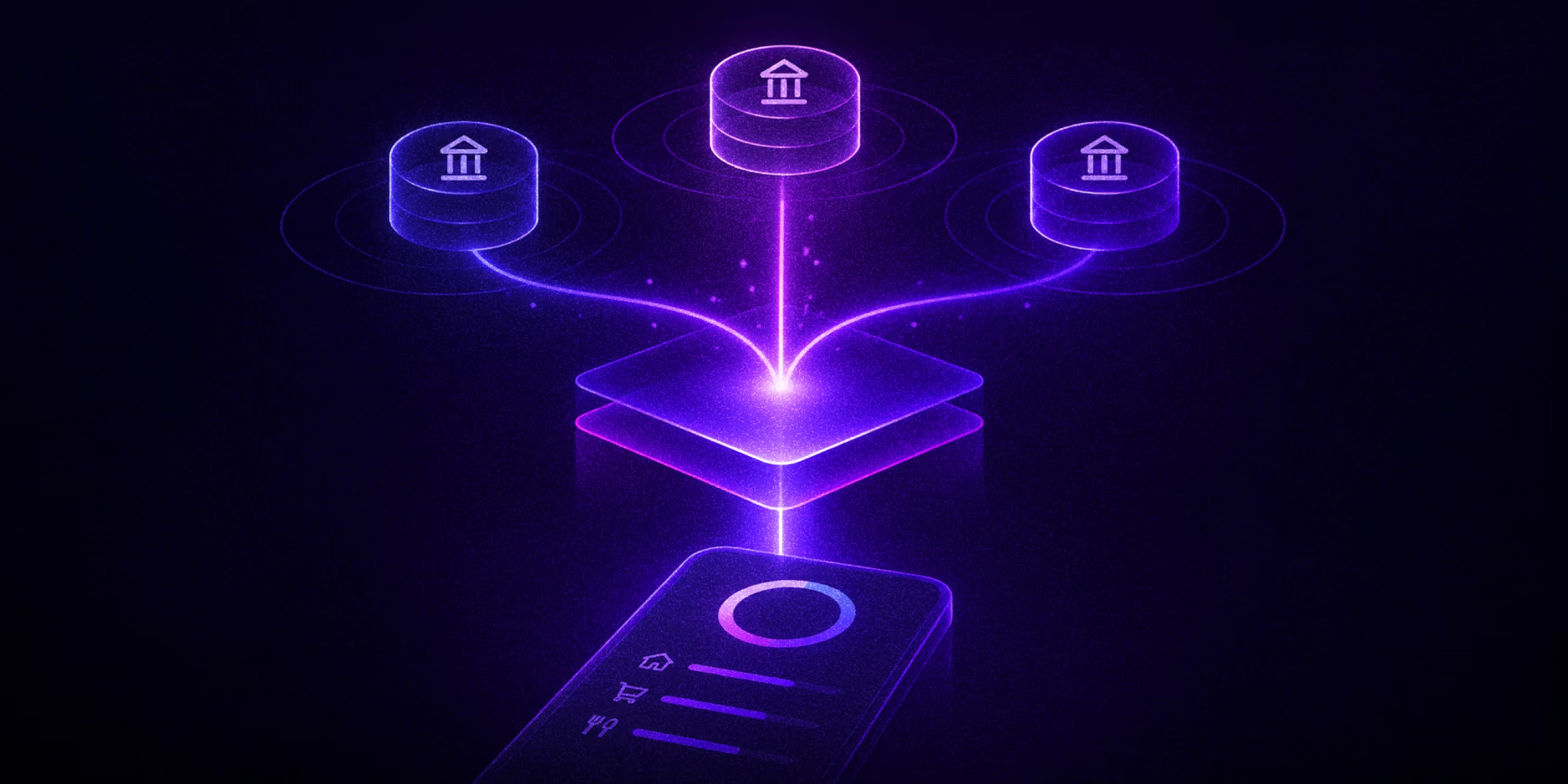
That means a unified layer that can route a connection request across Mastercard, MX, Plaid, and others. When one bank-to-aggregator integration atrophies or a specific OAuth flow fails, a backup integration can register the connection seamlessly. Data normalization across providers means that downstream systems like accounting, reconciliation, and cash-flow underwriting don't have to worry which provider delivered the transaction.
The most efficient way to accomplish this, while saving capital investment on thousands of direct integrations, is to partner with the aggregators that already have them.
What B2B connectivity unlocks
When B2B connectivity works, multiple huge markets modernize and expand:
- Cash-flow underwriting. The shift from bureau-based credit files to real-time cash-flow analysis, already underway on the consumer side, is nearly impossible to scale for business lending without reliable B2B bank data feeds.
- Treasury and CFO tooling. Multi-account balance visibility, forecasted runway, intercompany cash movement become automatable the moment the underlying feeds are reliable.
- Vertical SaaS. Every vertical SaaS company serving small and mid-sized business (HVAC platforms, field-service tools, fleet-management software, etc) benefits from banking data to optimize workflows and facilitate lower-cost payments.
- Bookkeeping and fund accounting. Automated reconciliation has existed for years, but accountants often need the authoritative bank-issued PDF statement to close the books.
How B2B fintech catches up to the consumer players
The companies that matter in the next decade of fintech infrastructure will not be the ones that raise the most capital to build the most direct integrations. The moat is relational and architectural, not necessarily capital-intensive.
B2B applications will lead this shift precisely because they were left behind in a consumer-first era. No single aggregator will dominate business banking the way some dominated consumer fintech in the 2010s. The volume is lower. The long tail is longer. The willingness to pay is higher. These unit economics reward coverage over scale. Business account aggregation is a different and premium market ready to mature.
A unified API for open banking like Quiltt gives fintechs, commercial platforms, and treasury tools a single integration. Our model with one widget and one contract enables best-in-class coverage across multiple aggregation providers, with normalized data, automated connection routing, and enterprise-grade reliability. This same infrastructure handles advanced categorization, insights, and analytics using best-in-class AI enrichment providers like Fingoal, MX, Ntropy and Pave. The same functionality that makes consumer apps shine finally gives B2B fintech a foundation to build on.
Listen to the full conversation with Ruben on the Headless Banking podcast, hosted by Jeff Forkan of TreasuryPath — the multi-bank treasury platform for commercial finance teams, and a Quiltt customer.
Frequently Asked Questions
What is B2B open banking and how is it different from consumer open banking?
B2B open banking refers to API-based data sharing between financial institutions and business applications like enterprise resource planning, treasury management, and vertical SaaS platforms. In consumer open banking, one person typically connects one or more accounts - usually 5 or fewer; B2B use cases can involve many business accounts across smaller banks focused on business customers, often with low aggregator coverage. The infrastructure requirements, reliability expectations, and budget are all fundamentally different.
Can a company just build its own screen scraper for bank connectivity?
Technically, yes, and AI tooling makes it easier than ever to do so. But this path is problematic:
- It puts customer credentials at risk
- It puts the company in potential conflict with bank terms of service
- It creates brittle infrastructure that breaks with any front-end change
- It undermines the open banking ecosystem that was specifically designed to prevent credential sharing.
For regulated fintech companies, the compliance and reliability costs of self-built scraping almost always outweigh the perceived short-term benefits.
Why doesn't a provider like Plaid have business bank coverage that matches consumer bank coverage?
Plaid, like most aggregators, prioritizes its coverage around expected volume. The institutions that power consumer fintech (e.g. Chase, Bank of America, Wells Fargo) get prioritized because they drive the most connections and therefore the most revenue. Business-focused banks like Brex, Ramp, and Mercury, along with thousands of smaller commercial banks, usually fall outside the top 100 most-integrated institutions at any major aggregator. The underlying commercial model wasn't designed for the long-tail, high-value connectivity that B2B fintech requires.
Why is orchestration so important for B2B fintech apps?
An orchestration platform routes connection requests across multiple bank data aggregators through a single integration, allowing fintech apps to get broader bank coverage and automatic failover between providers. No single aggregator has anywhere close to full coverage of the commercial banking stack, making using multiple providers essential.
What is CFPB Rule 1033 and what does it mean for business banking data?
CFPB Rule 1033 (the Personal Financial Data Rights rule) was designed to give consumers the right to access and share their financial data via secure APIs, effectively replacing screen scraping. While enforcement has been uneven, the rule signals the long-term direction of the industry. For business banking, CFPB Rule 1033 currently has limited direct impact, as the focus of the rule has been on consumer accounts. Rule 1033 did accelerate bank investments in API infrastructure at the larger institutions, but it also increased the detection and blocking of screen scraping across the industry. Furthermore, the rule has been in-limbo since the start of the current presidential administration.

.avif)